The 2009 March Starmap!
March is more-or-less here, and before I get to the upcoming constellations, I wanted to bring a few awesome stargazing opportunities to your attention!
This year is the International Year of Astronomy – and the 400th Anniversary of Galileo’s observations of Jupiter. Celebrate by doing some stargazing of your own. Here are just a few upcoming easy worldwide stargazing projects you can participate in!
Go outside any one of the above dates and take a look at Orion – no telescope or binoculars needed. GLOBE at Night wants to know how many stars you can see with just your eyes. But wait! They make it easy – you don’t have to count the stars – just compare what you see to diagrams, and pick the one that matches and submit your observations online. This data will be compiled into maps which will help astronomers track light pollution and how stargazing quality in various parts of the world.
Go to their webpage, download an observation packet, and take your family out to your backyard for some real science!
You’ll need to know your latitude and longitude:
Seattle is at: 47o37’N, 122o20’W
8:30pm Saturday, March 28, 2009 – Earth Hour
All you have to do for Earth Hour is turn off your lights – especially your outdoor lights for one hour at 8:30pm on March 28th. It’s that easy. And you might as well take that time to head outside and do your Orion observing for the GLOBE at Night project we just talked about! Earth Hour is about energy conservation and doing something about climate change – with the added benefit of supporting Dark Skies Awareness and making stargazing awesome even in big cities.
You can sign up and get more information, or just turn off your lights. Tell a friend; ask your neighborhood businesses to participate. Anything you do helps.
One of the cornerstone goals of the International Year of Astronomy is to get as many people in the world to look up at the sky, and to look through a telescope as possible. To work toward this this there’s going to be a 100-hour-long extravaganza of worldwide observing events. Here at Pacific Science Center we’ll be having our Earth Observation from Space month (all of April) where you can meet scientists and participate in hands-on activities on six designated research days.
Don’t have a telescope to do your own observing? No problem – join the 100 Hours of Astronomy team for a 24-hour webcast from research observatories around the world.
Be warned, when you visit their website – they write dates in the European style, so what we would call 04/01/2009, they’ll write as 01/04/2009! Shows you just how worldwide this project is!
And Now for the Constellations and Observables in the March-April Sky:
Notable Sky Objects
VENUS
I know, I said exactly this last month, but it’s still true! It may not be on my map, because the map is for later in the evening, but Venus is spectacular low in the southwest just after sunset. If you’ve got clear enough skies, poke your head out and learn why Venus has earned the moniker “the evening star.” (In June you’ll be able to poke your head out early in the morning and learn why Venus ALSO earned the moniker “the morning star.”) Venus will ONLY be visible for the month of March – by April it will be too close to the Sun from our point of view.
SATURN
Oh Saturn – with its rings tilted almost edge on to us, you really shouldn’t miss it. It’s beautiful, and with a little telescope you’ll at least be able to see its bright moon Titan, or the sliver of the rings running around the planet.
COMET LULIN
It’s not on my map because it’s moving too fast. Start by looking up some maps on Sky and Telescope, or somewhere like that, then gaze towards Saturn with a pair of binoculars. I know I’ve told you before that comets don’t streak across the sky – but this one is moving fast enough that you can notice the motion in just a short observation time. (It won’t look like it’s moving, but you’ll notice its position in relation to the background stars changes slightly over time). Once again, it won’t streak – if you see that it’s a meteor or an airplane. Moving a little slower? That’s a satellite. A dim smudge that doesn’t seem to move? That’s probably the comet, but don’t get it confused with M13, the Hercules Globular Cluster.
Watch for a full-serving AstroInfo on Comet Lulin coming up later this week!
New Constellations
BOÖTES – The Herdsman
SCIENCE: Arc to Arcturus, Speed on To Spica. This is how you find Boötes using the curve of the handle of the Big Dipper – and then that leads you on to Spica in Virgo!
Tau Boötes (sorta Boötes’ left foot) has an extrasolar planet! One of the so-called hot Jupiters. You can see this star just to the right of Arcturus – it’s the crook (corner) star off the little triangle that you’ll see there.
MYTH: The modern myth is that Boötes invented the plow, and therefore farming, and he’s the only “regular person” up in the sky – everyone else is a God, or partially Godlike, or something. I love this myth, because I can explain that Boötes is why we have cell phones and planetariums. It turns out that several different cultures depict Boötes as a herdsman or a farmer: the Saudi Arabians, the Egyptians (to whom the Herdsman is so important he also represents Osiris), the Greeks, and the Christians. Yowsa.
VIRGO – The Virgin (or “Princess”)
SCIENCE: Arc to Arcturus, Speed on To Spica. This is how you find Boötes using the curve of the handle of the Big Dipper – and then that leads you on to Spica in Virgo!
We are part of the Virgo Cluster of galaxies – and it’s called the Virgo Cluster because to see the rest of the galaxies in our group you look towards Virgo. There’s a bunch of beauties out there by Virgo’s face, so if you’ve got a scope, take a look, and if you don’t, look up some pretty pictures of our group of galaxies – most of them are over there.
MYTH: Worried about talking about virgins in mixed company? Well, princess is a perfectly acceptable way to talk about Virgo, also “girl” is good too. If your audience is up to it, you might mention that this virgin usually represents the Greek goddess of justice – so I wouldn’t try to cross her if I were you.
CORONA BOREALIS – The Northern Crown
SCIENCE: There’s not much too Corona Borealis, but it is a very noticeable grouping of stars, and therefore quite helpful in finding Hercules, especially in our murky Seattle skies.
MYTH: Obviously the Greek myth is about a crown, but the Housatonic Native Americans call this Ursa Major’s cave!
HERCULES – Hercules
SCIENCE: Do not miss M13 – the Hercules Globular Cluster! This is one of the oldest groups of stars in our galaxy – it’s like the old-folks home of stars.
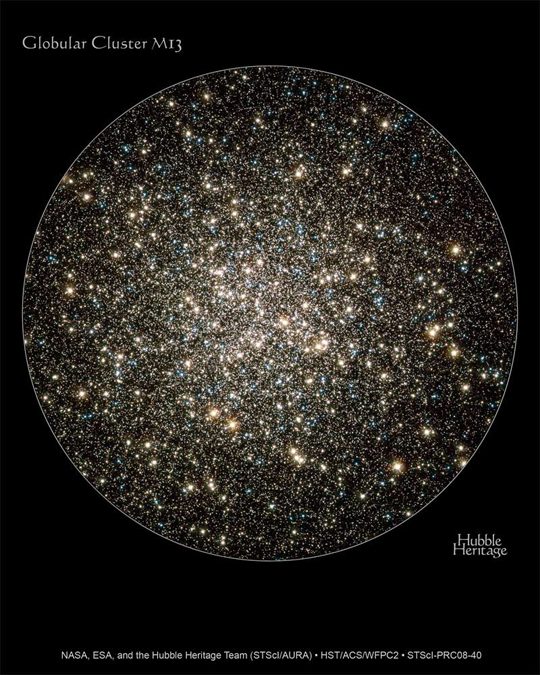
Hercules Globular Cluster by the Hubble Space Telescope
MYTH: “Hercules is one of the oldest constellations, found in the cave drawings of primitive cultures. Not even the Greeks were sure of his origins. We are aware that very early cultures worshipped him, but who and what his starry figure stood for is a mystery.
“About 300 BC the Chaldeans said that this figure was standing victorious on the head of a twisting serpent. They associated these two figures, Hercules and Draco (the serpent) with their sun god, Ishdubar.
“The Chinese called Hercules ‘Titso’ or ‘the emperor’s seat’.” (From Zeta Strickland)
“Tiny” Guys
Going for the Gold? Here’s this month’s itty-bittys.
SERPENS – The Serpent
LYRA – The Lyre (just starting to peek up)
CORVUS – The Crow
CRATER – The Cup
COMA BERENICES – Berenice’s Hair
CANES VENATICI – The Hunting Dogs
LYNX – The Lynx
SEXTANS – The Sextant
HYDRA – The Sea Serpent (Big and dim, so big that it’s close to being biggest Northern Hemisphere constellation)
ANTILA – The Air Pump (Maybe you’ll see it, but it might be too far south)
MONOCEROS – The Unicorn
LACERTA – The Lizard
LEO MINOR – The Small Lion (Between the Big Dipper and Leo)
CAMELOPARDALIS– The Giraffe
Returning Constellations
LEO – The Lion CANCER – The Crab CANIS MAJOR – The Big Dog ORION – The Hunter TAURUS – The Bull GEMINI – The Twins CEPHEUS – King Cepheus DRACO – The Dragon URSA MAJOR – The Great Bear URSA MINOR – The Little Bear CASSIOPEIA – The Queen
Happy Sky Viewing!
Alice Enevoldsen
Where’d I Get My Info?
My memory, and Zeta Strickland